After the latest edition of World
Heritage Sites in India, India has now 36 World Heritage Sites listed by
UNESCO and that makes India among one of the top countries globally in
terms of a number of world heritage sites. UNESCO identifies World
Heritage Sites as places that belong to all the peoples of the world,
irrespective of the territory on which they are located. This means
these World Heritage Sites in India are considered to be of immense
cultural and natural importance in the world. Have a look and find out
what the world appreciates the most about your country.
Here is a list of 36 UNESCO World Heritage Sites in India:
1. Taj Mahal-Agra
Taj Mahal, Uttar Pradesh
One of Seven Wonders of the World, White Marble Mughal Architecture, the Taj Mahal
was build by emperor Shah Jahan in the memory of his wife Mumtaj Mahal.
It is located at the bank of river Jamuna in Agra. It was completed in
1653 with then estimated cost of 32 million Indian rupees which would
today stand upto 58 billion Indian rupees. It is considered as the best
example of Mughal architecture worldwide and is called the “Jewel of
Muslim Art in India”. This is probably the monument that is most
recognised the world over for its association with the heritage of
India.
2. Khajuraho, Madhya Pradesh
Khajuraho, Madhya Pradesh
Located in Madhya Pradesh, Khajuraho is an important UNESCO World Heritage site in India.
Khajuraho is unique heritage site which is famous for a group of Hindu and Jain Temples situated 175 km south-east of Jhansi. They are well known for their Nagara style symbolism and erotic figures and sculptures. These sensuous stone carvings of human and animal form in erotic poses are very aesthetically portrayed and stand testimony to the rich cultural heritage of India. Most of these monuments were built between 950 to 1050 CE under the reign of the Chandella dynasty. It consists of total 85 Temples spread across an area of 20 square kilometres. The Kandariya temple is the most prominent of all of these temples in the Khajuraho complex.
3. Hampi, KarnatakaAchyutaraya Temple, Hampi, Karnataka
Hampi is a UNESCO World Heritage site located in the Northern part of
Karnataka. It lies within the ruins of the ancient, prosperous kingdom
of Vijayanagar. The ruins at Hampi are a collection of heritage sites depicting the fine Dravidian style of art and Architecture.
The most important heritage monument in this site is the Virupaksha
Temple, which continues to be a very important religious centre for the
Hindus. There are several other monuments which are a part of this
heritage site, Together, they’re collectively known as the ‘Group of
Monuments at Hampi’. Some of the other known ones include the Krishna
temple complex, Narasimha, Ganesa, Hemakuta group of temples,
Achyutaraya temple complex, Vitthala temple complex, Pattabhirama temple
complex, Lotus Mahal complex, several puras or bazaars surrounding the
temple complex, and also living quarters and residential areas.
4. Ajanta Caves, MaharashtraAjanta Caves, Maharashtra
Famous for/as: Buddhist Rock-cut Cave Monuments, Richly Decorated Paintings and Frescoes similar to Sigiriya Paintings.One of the first World Heritage sites in India, the Ajanta Caves, Maharashtra date back to around 2nd century BCE to 650 CE and consist of the finest masterpieces of 31 rock cut Buddhist cave monuments, paintings and sculpture. The caves very built in two different phases. First of Satavahana Period under the patronage of Satvahana Dynasty (230BCE-220CE). Second, the caves of Vakataka Period under the reign of Emperor Harishena of Vakataka Dynasty. The style of Ajanta art and architecture has had a revolutionary impact on the way in Indian art and architecture has progressed all throughout history. Having mainly carvings and sculptures related to the life of Buddha, one can say that this marks the beginning of Indian Classical Art.
5.Ellora Caves, MaharashtraEllora Caves, Maharashtra
Famous for/as: Buddhist, Jain and Hindu Temples and Monasteries, Caves Excavated out of Hills, Rock-cut Architecture.The Ellora Caves are an important UNESCO World Heritage site and an archaeological site, ranging 29 kilometers Northwest of the city of Aurangabad. The Ellora Caves, are well known for their Indian-rock cut architecture. There are about 34 rock cut temples and caves which can be dated to about 600 to 1000 AD, are important in terms of understanding the lives of the people living in these times. The presence of Hindu, Buddhist and Jain temples and sculptures portray the tolerance which was extended towards different faiths and beliefs in Ancient Indian History. Excavated site consists of Charanandri Hills, Buddhist Hindu and Jain rock-cut temples, Viharas and Maths of 5th and 10th century.
6. Bodh Gaya, Bihar
Mahabodhi Temple Complex, Bodh Gaya, Bihar
Bodh Gaya, is located almost 96kilometrese away from Patna, Bihar and
is one of the UNESCO World Heritage sites in India. It’s an important
religious centre for the Buddhists as this was the place where Mahatma
Buddha attained enlightenment. The holy Bodhi Tree is the site where
Siddhartha gained Enlightenment and became Gautam Buddha. The famous
Mahabodhi Temple was established in the reign of Ashoka the Great in
about approximately 250 BCE. It’s one of the earliest Buddhist temples.
Currently, the Mahabodhi Temple Complex at
Bodh Gaya comprises the 50 m tall Mahabodhi Temple, the Vajrasana,
sacred Bodhi Tree and other six sacred sites of Buddha’s enlightenment,
surrounded by numerous ancient Votive stupas. Owing to all these
factors, Bodh Gaya is considered to be the most holy pilgrimage spot for
the Buddhists.7. Konark, Odisha
Sun Temple, Konark, Odisha
Famous for/as: Black Pagoda, Chariot of the Sun, Kalinga Architecture, Included in Seven Wonders of India.Not very far from the popular beach town of Puri, the Sun Temple at Konark is a 13th century temple situated in Konark, Odissha. It was built by king Narasimhadeva I of the Eastern Ganga Dynasty in around AD 1250. The Sun Temple is in the shape of a gigantic chariot with carved stone wheel, pillars and walls and is led by 6 enormously carved horses. It’s also considered to be one of the largest brahmin sanctuaries in India. The temple is originally said to be built at the mouth of river Chandrabhaga but the waterline receded since then. This World Heritage Site in India reflects the grandeur of the traditional style of Kalinga Architecture which was prevalent then.
8. Red Fort, Delhi
Red Fort, Delhi
Situated in the centre of the historic city of New Delhi, the Red Fort was built by emperor Shah Jahan when he shifted his capital from Agra to Delhi, or what was known as Shahjahanabad at that time. The fort became the political hub of the Mughals. Under Shah Jahan, Mughal art and architecture reached it’s zenith, and the Red Fort is the perfect example of that. One can see the blending of Indo-Islamic, Timurid, Hindu and Persian forms of architecture in several facets of the Red Fort. It’s made up of red sand stone and houses several other smaller buildings such as the private pavallions, the Diwan-i-aam, the Diwan-i-khas. The Red Fort is one of the most popular UNESO World Heritage Sites in India and is managed directly by the Archaeological Survey of India.
9. Sanchi, Madhya Pradesh
Sanchi Stupa, Madhya Pradesh
The Buddhist Monuments located at Sanchi in Madhya Pradesh are a World Heritage Site in India and they are the oldest stone structures in India. Originally commissioned by emperor Ashoka in 3rd century BCE, the Sanchi Stupa, is located 46 kilometer north-east of Bhopal. Its core was a hemispherical brick structure built over the relics of Buddha and was crowned by the Chatra which symbolizes rank. The stupa was vandalized during 2nd century BCE and renovated during the Satavahana Period when the gateways and the balustrade were built and colored. Apart from the Sanchi stupa, several other structures exist here, such as monolithic pillars, temples, palaces and monasteries. It remained a major pilgrimage site for the Buddhists till about 12th century AD, after which the religion declined in popularity.
10. Cholas, Tamil Nadu
Brihadeshwar Temple built by the Cholas, Tamil Nadu
Brihadisvara Temple, Thanjavur, Brihadisvara Temple, Gangaikondacholisvaram and Airavatesvara Temple, Darasuram.
Famous for/as: Chola Architecture, Sculpture, Painting and Bronze Casting.These temples were built in Southern Part of India during the rule of Chola empire. The Brihadisvara Temple, the Temple at Gangaikonda Cholapuram and the Airavatesvara Temple are the most important of all of these temples. The Brihadisvara temple was built under the reign of Rajaraja 1, and is a milestone when it comes to Chola architecture. The temple at Gangaikondacholapuram was patronized by Rajendera 1 and was dedicated to Lord Shiva. And the the Airavatesvara temple was built during the time of Rajaraja II, and is aesthetically different from the other two. These temples stand testimony to the architectural splendour and beauty of Chola art, architecture and sculpture. These temples are living temples and the rituals and festivities which were observed by people thousands of years ago, are still held. Hence, these 3 temples reflect the ancient culture and heritage of the Tamilians and form an inseparable part of their ancient history.
11. Kaziranga National Park, Assam
One-Horned Rhino, Kaziranga National Park, Assam
Famous for its one horn rhinoceroses, Kaziranga National Park, Assam is located in Assam and is one of the untouched natural areas in India. It is said that this World Heritage Site in India, was a project initiated by the Lord Curzon when his wife failed to see a single Rhinoceros in the region and urged her husband to take measured regarding protection of these endangered species. This park lies on the flood plains of the river Brahmaputra and consists mainly of dense grasslands, forests and also has several streams and lakes running through it. Kaziranga contains about 15 endangered Indian faunal species, of which the Rhino is the most endangered. Other mammals include capped langur, hoolock gibbon, tiger, leopard, sloth bear, Ganges dolphin, otter, wild boar, water buffalo, gaur, sambar, swamp deer, hog deer and Indian muntjac.
12. Group of Monuments at Mahabalipuram, Tamil Nadu
The Shore Temple, Mahabalipuram, Tamil Nadu
The Pancha Rathas Temples, Ganesha Ratha, Cave Temples of Mahabalipuram, Structural Temples including the Shore Temple and the Olakkannesvara Temple and the Descent of the Ganges.
Famous for/as: Largest Open Air Rock Relief, Chariot Temples, Mandapas, Pallava Dynasty Architecture.The Temples are situated in the town of Mahabalipuram which is approximately 58 kilometers from Chennai in the Coromandal Coast of Bay of Bengal. These temples were built under the reign of the Pallava rulers and the striking feature of these temples is the fact that they are all carved out of rock and an important in terms of ratha architecture in India. The group of monument includes 40 sanctuaries including largest open-air-bas-relief, eg, Ganga’s Descent. These World Heritage Sites in India, constitutes the art of Pallava Period with sites likes Pancha Raths, Dharamaraja Ratha, Arjuna Ratha, Draupadi Ratha, etc. Also the Cave temple of Mahabalipuram which constitutes more than half a dozen caves.
13. Sunderbans National Park, West Bengal
Sunderbans National Park, West Bengal
Famous for the Royal Bengal Tigers, the Sunderbans National Park is a known Tiger reserve and a Biosphere reserve located in the Indian State of West Bengal. It is situated on the Sunderban Deltas formed by the river Ganges in Bay of Bengal. It is one of the largest reserves in India covered mostly by dense Mangrove forests. It’s the world’s largest mangrove forest reserve. Home to the critically endangered Royal Bengal Tiger, there are also other animal species such as the gangetic dolphin, spotted dear, wild boar and other mammal and amphibian species. The rare salt water crocodile is another attraction of this reserve. The tiger population of India is the maximum in this location. Because of frequent contacts with local inhabitants, several tigers have been labelled as ‘man-eaters’.
14. Humayun’s Tomb, New Delhi
Humayun’s Tomb, New Delhi
This World Heritage Sites in India was built by Begum Bega, the first wife of Humayun between 1565-1572. IT is the only monument which has gone several restoration work and is complete. It’s a tomb complex consisting of several smaller monuments including the tombs of Isa Khan Niyazi, an Afghan noble in Sher Shah Suri’s court of the Suri dynasty.
15. Jantar Mantar, Jaipur, Rajasthan
Jantar Mantar, Jaipur, Rajasthan
The Jantar Mantar is an astronomical observatory built in 18th century Rajasthan. It is an astronomical observatory which was built by the Rajput King Sawai Jai Singh of Rajasthan in 1738 CE. It is a collection of 19 astronomical instruments including world’s largest stone Sundial. All these instruments are man-made. The observatory consists of instruments which were used to calculate celestial coordinate systems, the horizon-zenith local system, the equatorial system and the ecliptic system. One of India’s best preserved observatories, this monument is a great example of the scientific as well as the cultural heritage of India.
16. Agra Fort, Uttar Pradesh
Agra Fort, Uttar Pradesh
17. Fatehpur Sikri, Uttar Pradesh
Fatehpur Sikri, Uttar Pradesh
so contained the Diwan-e-khas and Diwan-e-aam. Interior to the Buland Darwaza lies the Tomb of Salim Chishti. All these Mughal buildings are a part of the World Heritage Sites in India.
18. Rani Ki Vav, Patan, Gujarat
Rani Ki Vav, Patan, Gujarat
19. Group of Monuments at Pattadakal, Karnataka
Virupaksha temple and Kashivishvanath, Pattadakal, Karnataka
20. Elephanta Caves, Maharashtra
Elephanta Caves, Maharashtra
The Elephanta caves are located on an island in the Arabian City, not very far from the city of Mumbai. The chain of sculpted caves located on Elephanta Island is also known as Gharapuri. There are numerous archaeological remains which offer us a glimpse into the rich. cultural past of Indian civilization. These caves are famous for their rock-cut sculptures and carvings depicting Shiva as the Creator and the Destroyer of the Universe. The most important of all the caves here is Cave 1, where one can see the Sadashiva at the entrance of the cave, which depicts 3 sides of Shiva: as the Creator, Preserves and Destroyer. The caves are carved in solid basalt rock and lie 10 kilometers east to the city of Mumbai
21. Nalanda Mahavihara (Nalanda University), Bihar
Nalanda Archaeological Site in Bihar was a centre of learning and a Buddhist monastery from 3rd century BCE to the 13th century CE. You can witness the remains of stupas, shrines and viharas if you stroll around in the campus of this manifestation of a glorious epoch. Nalanda vouched for evolution of Buddhism as a religion and remained an abode of knowledge for 800 years. Known for its formalised Vedic learning, scholars from as far as Tibet, China, Korea, and Central Asia once attended this first residential university of the World.
22. Chhatrapati Shivaji Terminus (formerly Victoria Terminus), Maharashtra
Chhatrapati Shivaji Terminus, Mumbai, Maharashtra
Chhatrapati Shivaji Terminus formerly known as the Victoria Terminus is the headquarters of Central Railway in Mumbai. It was built by Frederick William Stevens with the inspiration from Victorian Italianate Gothic Revival architecture and traditional Mughal buildings between the years 1878-1888, and gave Bombay the face of being the International Mercantile Port of India. In some ways, the plan of the terminal though it has Italian and Victorian era elements, reminds us of the Indian palace architecture, and is a good example of the blending of an indigenous and western style of art. Due to several reasons such as pollution, traffic, construction work etc, there have been reports of damages to this site. More work needs to be done to ensure the preservation of this heritage site.
23. Mountain Railways of India
Kalka-Shimla Train, Himachal Pradesh
24. Qutb Minar and its Monuments, New Delhi
Qutb Minar Complex, New Delhi
Qutb Minar, Alai Darwaza, Alai Minar, Qubbat-ul-Islam Mosque, Tomb of Iltumish, and Iron Pillar.
One of the most popular World Heritage Sites in India, the Qutub Minar was built in 1193 by the first Muslim ruler of Delhi Qutub-ud-din Aibak of the Mamluk Dynasty, after defeat of Delhi’s last Hindu Kingdom. The Qutub Minar is one of the several other buildings located within the Qutub complex, and it occupies the centre stage mainly due to it’s height. It is 73 meter tall and has a diameter of 15 m at the base and 2.5 m at the top. It was built by Aibak to honor the famous Sufi saint Qutbuddin Bakhtira Kaki. Near to Qutub Minar is the Quwwat-ul-Islam mosque, which was built on the ruins of the Lal Kot of the previous Hindu kingdom and is also known to be one of the firts mosques in the country. It is also famous for its brick minarets surrounding it.. These monuments are collectively known as the Qutub Minar Complex and represent one of the earliest known symbols for Islamic Architecture in India.25. Shahar ki Masjid, Champaner, Gujarat
Shahar ki Masjid, Champaner, Gujarat
26. Great Himalayan National Park, Himachal Pradesh
The Great Himalayan National Park, Himachal Pradesh
Spread over an area of 754.4 square kilometers, the Great Himalayan National Park is one of India’s National Parks located in the Kullu region of Northern Himachal Pradesh.
The park includes the upper mountain snow melt and glacial water melt
origins of several rivers, mainly the tributaries of the river Indus. It
is home to about 375 fauna species and several floral
species, including some very rare species of plants and animals such as
blue sheep, snow leopard, Himalayan brown bear, Himalayan Tahr, musk
deer spruces, horse chesnuts and huge alpine meadows. It is one of the
newer additions to the list of World Heritage Sites in India and is a
part of the Himalayan Biodiversity Hotspots. Coniferous Forests, Snowy Peaks (elevation range of 4,100m), Pristine Glaciers adds
sublime colours to its beauty. It’s a wildlife conservation site, hence
hunting of any of these animals is strictly prohibited.
27. Hill Forts of Rajasthan
Kumbhalgarh Fort, Rajasthan
One of the recent additions to the list of World Heritage Sites in India (2013), this place is famous for its unique Rajput Military Defense Architecture. It includes six majestic forts in Chittorgarh, Kumbhalgarh, Ramthambor Fort, Gagron Fort, Amber Fort and Jaisalmer Fort.
They’re located on the rocky Aravalli Mountain Range in Rajasthan. The
sheer length and expanse of the forts is enough to portray the power and
strength of the Rajputana rulers and chieftains. The fortifications of
these forts are extremely strong. Within the walls of the fort, it was
almost as if a mini-city existed. There were several markets, bazaars,
palaces, temples, urban and trading centres etc. And we know this as
some of them have survived. Also, these forts had unique water storage
and harvesting structures, which are actually being used even today. It
is also known for being the Shooting location of the movie, The Dark Knight Rises and a few movies of Satyajit Ray like ‘Shonar Kella’.
.
28. Churches and Convents of Goa
Church of St. Francis of Assisi, Goa
Includes:
Saint Catherine’s Chapel, Church and Convent of Saint Francis of Assisi, Basílica do Bom Jesus, Igreja de São Francisco de Assis, Church of Saint Cajetan and its seminary, Church of Our Lady of the Rosary and Church of Saint Augustine.
The 15th and 16th centuries mark the
coming of the Portugese to India and they established themselves at Goa,
along the Konkan coast in the South-western part of India. And the
advent of the Portugese marks the introduction of Christianity in the
Indian subcontinent. Hence, several churches and convents were built in
Goa, as a way of evangelization. Due to
their different, yet beautiful architectural forms, these churches have
been included in the list of UNESCO World Heritage Sites in India.
Famous for/as: Rome of the Orient, First Manueline, Mannerist and Baroque Art Forms in Asia, First Latin Rite Mass in Asia. Churches in goa
are examples ofthe development of architecture, sculpture and paintings
by spreading forms of Manueline, Mannerist and Baroque art throughout
the countries of Asia where Catholic Missions were established. They
were built by Portuguese colonial rulers in the region now known as Old Goa. The most famous among these monumnets is the Basilica do Bom Jesus
which contains the relics of St. Francis Xavier. This place serves as
an example of the diverse religious and cultural heritage of India.
29. Rock Shelters of Bhimbetka, Madhya Pradesh
Rock Shelters of Bhimbetka, Madhya Pradesh
Famous for/as: Rock Paintings within Natural Rock Shelters, Stone Age Inscriptions, Sitting Place of Bhima (Mahabharata).
Declared a Unesco World Heritage Site in 2003, the Rock shelter of Bhimbetka is the place were the earliest traces of human life on Indian subcontinent
was discovered. They’re located at the foothills of the Vindhaya
Mountains in the Deccan Plateau and are an archaeological site for the
Mesolithic period (more than 100,000 years ago) and
thus indicates the beginning of the South Asian Stone Age. The rock
shelters comprise a group of 5 rocks which were discovered only in 1957,
and are renowned for the Mesolithic era carvings and paintings. These
paintings are instrumental in telling us about the life and activities
of the hunter gatherers who preceded us, and shows the coming together
of art form and landscape, during that age.
30. Manas Wildlife Sanctuary, Assam
Kingfisher, Manas Wildlife Sanctuary, Assam
Famous for/as: Project Tiger Reserve, Elephant Reserve and Biosphere Reserve, Assam Roofed Turtle, Hispid Hare, Golden Langur and Pygmy Hog.
Manas Wildife Sanctuary is a protected
wildlife reserve and one of the UNESCO World Heritage sites in India.
It’s located in the North Eastern Indian state of Assam. The name
originated from River Manas which is derived from the name of Godess
Manasa. The lush green forested hills and dense vegetation of the
surrounding areas provide a comfortable environment to the several
endangered species of animals who reside here. The Wildlife Sanctuary, is a Project Tiger Reserve, Elephant Reserve, Biosphere Reserve and a
home for number of endangered species like Assam Roofed Turtle, Hispid
Hare, Golden Langur and Pygmy Hog. In fact this park houses most
endangered species than any other in India.
31. Keoladeo National Park, Bharatpur, Rajasthan
Keoladeo National Park, Bharatpur, Rajasthan
Famous for/as: Man-Made Wetland Bird Sanctuary, Siberian Cranes, Hotspot for Ornithologists.
Also known as Bharatpur Bird sanctuary,
Keladeo National Park is located in the Indian state of Rajasthan. A
home to about 366 different species of birds, it’s also known for being
the wintering and nesting ground for several non-indigenous, migratory
birds. Initially a duck shooting ground, it was later on developed as a
completely man-made and man-managed wetland/place, and is spread
over 29 square kilometers. Hunting is now banned in this area and is a
punishable offence. Besides birds, there are 379 floral species, 50
species of fish, 13 species of snake, 7 species of lizard, 7 species of
amphibians, 7 turtle species and variety of other invertebrates. This
place is a reminder of the rich biological heritage of India.
32.Nanda Devi Valley of Flowers National Park, Uttarakhand
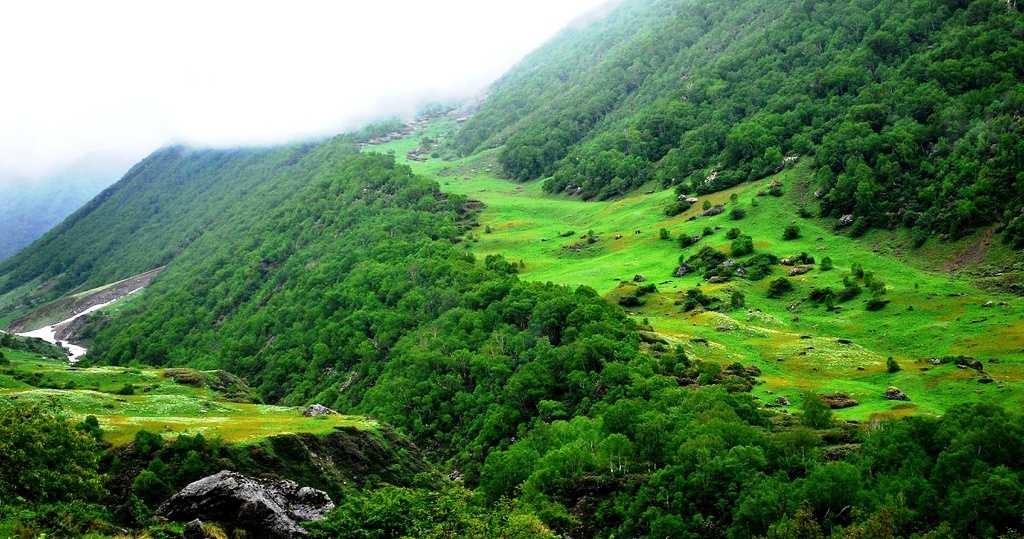
Valley of Flowers National Park, Uttarakhand
Famous for/as: Asiatic Black Bear, Snow Leopard, Brown Bear, Blue Sheep and Himalayan Monal, World Network of Biosphere Reserves.
The Nanda Devi is the highest mountain peak of Uttarakhand and the highest mountain
peak of India also because the Kanchenjunga is known to share its border
with Nepal. There are two peaks of the mountain, the eastern peak named
the Sunanda Devi. It has its importance back from the era of Puranas
and Upanishads, remarked several times in the mythological works of the
Hindus. It ranges upto a height of 6400 meters above the sea level.
The Valley of Flowers is a National Park near Nanda Devi peak which stretches upto 8
kilometers in length and 2 kilometers in width. It is famous for the
astonishing variety of flowers which covers the entire valley like a bed
sheet. This World Heritage Sites in India is home to more than 600
species of Flora and over 520 species of fauna.
33. Western Ghats
Anamali Hills (Western Ghats), Tamil Nadu
Includes:
Sahyadri Sub-Cluster, Kudremukh Sub-Cluster, Talakaveri Sub-Cluster, Nilgiri Sub-Cluster, Anamalai Sub-Cluster, Periyar Sub-Cluster and Agasthyamalai Sub-Cluster
Famous for/as: Among World’s Ten “Hottest Biodiversity Hotspots”, Includes many National Parks, Wildlife Sanctuaries and Reserve Forests.
The Western Ghats or the Sahyadri
mountain ranges lies along the western coast of Indian Peninsula. The
range runs north to south along the western edge of Deccan Plateau. It
constitutes sever national parks, reserve forests and wildlife
sanctuaries in Kerala , Karnataka, Tamil Nadu and Maharashtra. The hills
cover 160000 square kilometer area with a length of 1600 kilometer,
width of 100 kilometer and a heights of 1200 meters. It has an extremely
high bio-diversity and ranks among the top 8 in World’s Biological Hot
Spot Locations. The forests along the Western Ghats are home to about
325 species of flora and fauna, which included endangered, rare and
critically endangered species of plants and animals.
34. Khangchendzonga National Park, Sikkim
Kanchenjunga National Park.
35. Capitol Complex, Chandigarh
The Capitol Complex in Chandigarh also hosts the legislative assembly for both the states of Haryana and Punjab, High Court and the Secretariat. Located in Sector 1, Chandigarh, this capitol complex was built when Chandigarh was being developed as the capital of Punjab in 1950 after the partition of India.
36. The historic city of Ahmedabad
Pol in Ahmedabad
Ahmedabad is a walled city on the banks of Sabarmati where communities following Hinduism, Islam and Jainism have co-existed for centuries.
Comments
Post a Comment